
A hospital DR system should fit the work your imaging department does every day. Start with the number of examination types and patient volumes. Then look at generator power, tube capacity, detector performance, patient positioning, DICOM workflow and installation conditions. Long-term service is also important. Price should be part of the discussion but not the driving force behind it. A low quotation can become expensive when the system is too slow, hard to install, or poorly matched to the hospital’s workload.
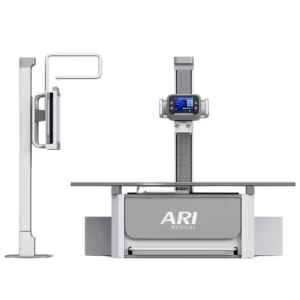
ARI Produtos para uso Médico is a Chinese medical equipment manufacturer and solution supplier with more than two decades of project experience. It brings manufacturing, research, development, production, and sales into one system, operates three production bases, and works under ISO 9001 and ISO 13485 quality systems. Its wider hospital-project background also covers installation guidance, operation training, maintenance training, and equipment matching. Its medical equipment is deployed in more than 500 hospitals, clinics, and healthcare facilities in China and has been exported to more than 100 countries. The company also supports international healthcare projects through equipment supply, installation guidance, operation training, and maintenance training. For a fixed digital radiography room, the ARQ-32/50/65/80 Digital Radiography X-ray System (Floor-mounted) is a practical model to place on the shortlist because it offers four generator power levels while keeping the same basic floor-mounted DR layout.

Which Clinical Needs Should Define the Hospital DR System?
The specification sheet matters, but your real starting point is the examination room. A system that works well in a small general hospital may be undersized for a busy regional center. The reverse is also true.
Selection Factor 1: Clinical Applications and Patient Volume
List all the examinations that you anticipate performing on a regular basis. The system can support all of the routine head, chest, abdomen, lumbar spine and limb studies. These studies can be performed in PA, LAT and horizontal table positions. That makes it suitable for common radiography work rather than one narrow application.
Next, estimate average and peak patient volume. A department handling steady outpatient work needs a different duty level from a room that receives emergency cases, ward referrals, and scheduled examinations at the same time. Leave some room for growth. Buying exactly for today’s volume often creates another purchasing problem sooner than expected.
How Much Generator Power and Tube Capacity Do You Need?
With a clear understanding of the workloads that are going to be required, you can now determine the required power without having to second guess it. The ARQ system is available with four generator power options: 32kW, 50kW, 65kW, and 80kW. The right choice depends on examination volume, tube current requirements, local power conditions, and expected daily workload.
Selection Factor 2: Generator Power
The 32kW version will be suitable for the moderate volume hospital carrying out routine radiography. Hospitals with higher volumes of radiography will require to consider the 50kW, 65kW or 80kW version. The current range is 10-400mA for the 32kW model and increases to 10-1000mA for the 80kW model with the mAs range also increasing.
Do not choose 80kW only because it is the largest number. Check your examination mix, expected patient load, local power supply, and budget. A well-matched 50kW system can be a better purchase than an oversized configuration that forces unnecessary electrical work.
A common purchasing mistake is choosing generator power by the highest available rating rather than actual workload. A hospital performing mainly routine chest, spine, and limb examinations may gain little from an 80kW configuration if a properly matched 50kW system already supports its patient volume. The larger system may instead increase electrical requirements and project cost.
Selection Factor 3: X-Ray Tube Heat Capacity
Generator power is only half the story. Key factors that affect repeated examination of a patient are the rotating-anode tube, the focal spot, the anode heat storage and the cooling rate. The anode heat storage is available in 3 configurations: 150kHU, 300kHU and 400kHU, and the cooling rate in 4 configurations: 475W, 600W, 800W and 1000W.
For a busy room, higher heat capacity and faster cooling give the tube more room during repeated exposure cycles. Ask the supplier to match the tube to your actual duty cycle, not just the generator label.
Which Detector Specifications Matter Most?
The detector has a direct effect on image acquisition and daily workflow. It also represents a large part of the system value, so vague wording such as “high-definition detector” is not enough.
Selection Factor 4: Flat Panel Detector Performance
O sistema utiliza um 17 × 17-inch flat panel detector with an amorphous silicon panel and cesium iodide scintillator. The listed active pixel matrix is 3072 × 3072, pixel pitch is 139μm, A/D conversion is 16 bits, spatial resolution is 3.6Lp/mm, and acquisition time is no more than one second.
A 17 × 17-inch field is useful for common chest, abdomen, spine, and limb work. The quick acquisition time can also help keep patient flow moving. Still, image performance should be checked with sample images, workstation functions, and the hospital’s own clinical expectations. One detector number never tells the whole story.
Can the System Fit Your Positioning and Digital Workflow?
A DR room is a working space, not a showroom. Staff need to position patients without fighting the equipment. Images also need to move into the hospital network without extra manual steps.
Selection Factor 5: Patient Positioning and Mechanical Range
This supports at least 1250mm vertical travel and 1800mm of travel left and right. In addition the stand supports a tube that can rotate up to 360 degrees. Furthermore the radiography table is of size 2200mm x 1040mm. The table supports a minimum of 150kg by means of electromagnetic locking. Finally the detector stand supports a minimum of 1100mm of vertical travel.
These figures matter when you image patients who cannot hold a standard position for long. Before ordering, map the movements inside the actual room. Check door clearance, table access, wheelchair approach, operator space, and service access.
Selection Factor 6: DICOM, PACS, HIS, and RIS Integration
This clinical workstation supports DICOM 3.0 queries to allow integration with PACS, HIS and RIS systems. The functions of this workstation are to support examination registration, case management, system integration, film printing and diagnostic reporting.
Ask your IT team to join the discussion early. Confirm network requirements, DICOM worklist needs, storage rules, printer use, and whether any local interface work is required. A technically strong DR X-ray system can still create delays when digital integration is left until installation week.
What Installation and Ownership Costs Should You Confirm?
The main unit price is only one line in the project budget. Room preparation, electrical work, shipping, installation, workstation setup, training, warranty, and spare parts can change the final cost by a wide margin.
Selection Factor 7: Room Layout and Power Supply
The 32kW version supports standard 220V single-phase or 380V three-phase input, with an optional 110V single-phase transformer. The higher-power versions use standard 380V three-phase input, with optional transformer arrangements for 220V or 110V single-phase supply.
Send the supplier your room drawing and local electrical details before asking for a final quotation. Confirm shielding requirements with qualified local specialists and follow local radiation rules. Also check floor conditions, cable routes, equipment access, air circulation, and the space needed for future maintenance.
Selection Factor 8: Total Cost, Warranty, Training, and Maintenance
Compare complete quotations line by line. The package should clearly state the generator, tube, detector, table, detector stand, workstation, monitor, software, DICOM functions, installation scope, training, warranty, and spare-part terms.
O publicado service and warranty terms state that X-ray machines carry a 14-month warranty and that spare parts and support are provided for at least eight years from delivery. You should still confirm the exact terms for your order, market, configuration, and installation arrangement in writing.
Is the ARQ-32/50/65/80 a Good Fit for Your Project?
This floor-mounted DR system is worth considering when you need routine digital radiography, several generator choices, a 17 × 17-inch detector, flexible tube and table movement, and DICOM-based workflow. It gives you room to match the configuration to a smaller hospital, a growing radiology department, or a busier imaging center without moving to a different basic platform.
Before requesting a proposal, prepare your hospital type, daily patient volume, main examinations, room dimensions, local voltage, PACS/HIS/RIS details, preferred power level, required certificates, delivery target, and training needs. Need help choosing between 32kW, 50kW, 65kW, and 80kW? Share your daily patient volume, main examinations, room dimensions, local voltage, and PACS requirements with the equipe de projeto for a configuration recommendation and quotation. A complete request gets a much more useful answer than a message asking only for the lowest price.
Perguntas frequentes
Q1: What Generator Power Is Best for a Hospital DR System?
A1: The right power depends on patient volume, examination types, duty cycle, room power supply, and future demand. The available 32kW, 50kW, 65kW, and 80kW configurations let you match the system to different hospital workloads.
Q2: Is a 17 × 17-Inch Detector Suitable for General Hospital Radiography?
A2: Yes. A 17 × 17-inch detector can cover common chest, abdomen, spine, head, and limb examinations, while also reducing the need for repeated detector repositioning in routine work.
Q3: Does the System Support DICOM and PACS Integration?
A3: Yes. The workstation supports DICOM 3.0 queries and can integrate with PACS, HIS, and RIS, subject to the hospital’s network setup and interface requirements.
Q4: What Should Be Included in a DR System Quotation?
A4: A clear quotation should list the generator, X-ray tube, detector, table, stand, workstation, software, DICOM functions, accessories, shipping, installation, training, warranty, and spare-part support.
P5: Que informações devo enviar antes de solicitar um orçamento?
A5: Send your hospital type, main examinations, daily patient volume, room size, local voltage, network requirements, preferred generator power, required documents, order quantity, delivery target, and service needs.